
Summary of AI-POWERED SNORE DETECTOR SHAKES THE PILLOW SO YOU WON’T
The article describes an AI-powered haptic snore detector built by Naveen Kumar that uses sound recognition to detect snoring and vibrate a pillow to prompt repositioning. It employs an Arduino Nicla Voice board with a Syntiant NDP120 deep-learning processor and MEMS microphone, trained on a public snoring dataset that includes non-snore sounds. The model runs on-board and triggers a haptic driver after detecting snoring multiple times. The project aims to alert sleepers to potential snoring issues and could be adapted as a wearable.
Parts used in the AI-powered haptic snore detector:
- Arduino Nicla Voice sensor board
- Syntiant NDP120 deep-learning processor (onboard the Nicla Voice)
- Built-in MEMS microphone (onboard the Nicla Voice)
- Public snoring dataset (for training the model)
- Online tool for training and downloading the model
- Haptic driver board
- Pillow or pillow-mounted vibration mechanism
If you snore, you’ll probably find out about it from someone. An elbow to the ribs courtesy of your sleepless bedmate, the kids making fun of you at breakfast, or even the lady downstairs calling the cops might give you the clear sign that you rattle the rafters, and that it’s time to do something about it. But what if your snores are a bit more subtle, or you don’t have someone to urge you to roll over? In that case, this AI-powered haptic snore detector might be worth building.
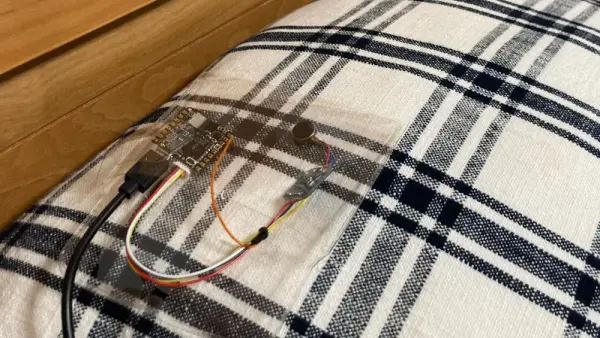
The most distinctive characteristic of snoring is, of course, its sound, and that’s exactly what [Naveen Kumar] chose as a trigger. To differentiate between snoring and other nighttime sounds, [Naveen] chose an Arduino Nicla Voice sensor board, which sports a Syntiant NDP120 deep-learning processor and a built-in MEMS microphone. To generate a model that adequately represents the full tapestry of human snores, a publicly available snoring dataset — because of course that’s a thing — was used for training. Importantly, the training data included samples of non-snoring sounds, like sirens and thunder, as well as clips of legit snoring mixed with these other sounds. The model is trained with an online tool and downloaded onto the board; when it detects the sweet sound of sawing wood three times in a row, a haptic driver board vibrates the pillow as a gentle reminder to reposition. Watch it in action in the brief video below.
Snoring is something that’s easy to make light of, but in all seriousness, it’s not something to be taken lightly. Hats off to [Naveen] for developing a tool like this, which just might let you know you’ve got a problem that bears a closer look by a professional. Although it might work better as a wearable rather than a pillow-shaker.
Source: AI-POWERED SNORE DETECTOR SHAKES THE PILLOW SO YOU WON’T
- What sensor board is used to detect snoring?
The Arduino Nicla Voice sensor board is used. - What processor handles the deep learning model?
The Syntiant NDP120 deep-learning processor on the Nicla Voice handles the model. - How is the snore detection model trained?
The model is trained via an online tool using a public snoring dataset and non-snore samples, then downloaded onto the board. - What kinds of sounds were included in the training data?
The training data included snoring, non-snoring sounds like sirens and thunder, and snoring mixed with other sounds. - What happens when snoring is detected multiple times?
A haptic driver board vibrates the pillow as a reminder to reposition. - Why use sound as the trigger for detection?
Snoring's distinctive sound is the primary characteristic used to trigger detection. - Could this setup be used in another form besides a pillow shaker?
The article suggests it might work better as a wearable rather than a pillow-shaker.
