
Summary of Guidelines for reading an optocoupler datasheet
This article explains the function of optocouplers (opto-isolators) in transferring electrical signals via infrared light while isolating circuits from high voltages. It details the standard structure of optocoupler datasheets, using the VO617A as an example. The text outlines essential datasheet sections, including descriptions, features, applications, safety approvals, ordering info, and various technical specifications like CTR, switching characteristics, and packaging dimensions to help engineers interpret component data effectively.
Parts used in the Optocoupler Datasheet Analysis:
- Infrared light-emitting diode
- Phototransistor
- VO617A optocoupler
- Datasheet document
Optocouplers, also known as opto-isolators, are components that transfer electrical signals between two isolated circuits by using infrared light. As an isolator, an optocoupler can prevent high voltages from affecting the side of the circuit receiving the signal. Transferring signals over a light barrier by using an infrared light-emitting diode and a light-sensitive product, such as a phototransistor, is the main structure of an optocoupler. On the first page, datasheets provide the main product description, its features, suggested areas of applications, ordering information, and agency approvals, as shown in Figure 1 for the VO617A optocoupler with phototransistor output. Following pages provide key technical specifications, operating conditions, and graphs showing the behavior of the product.
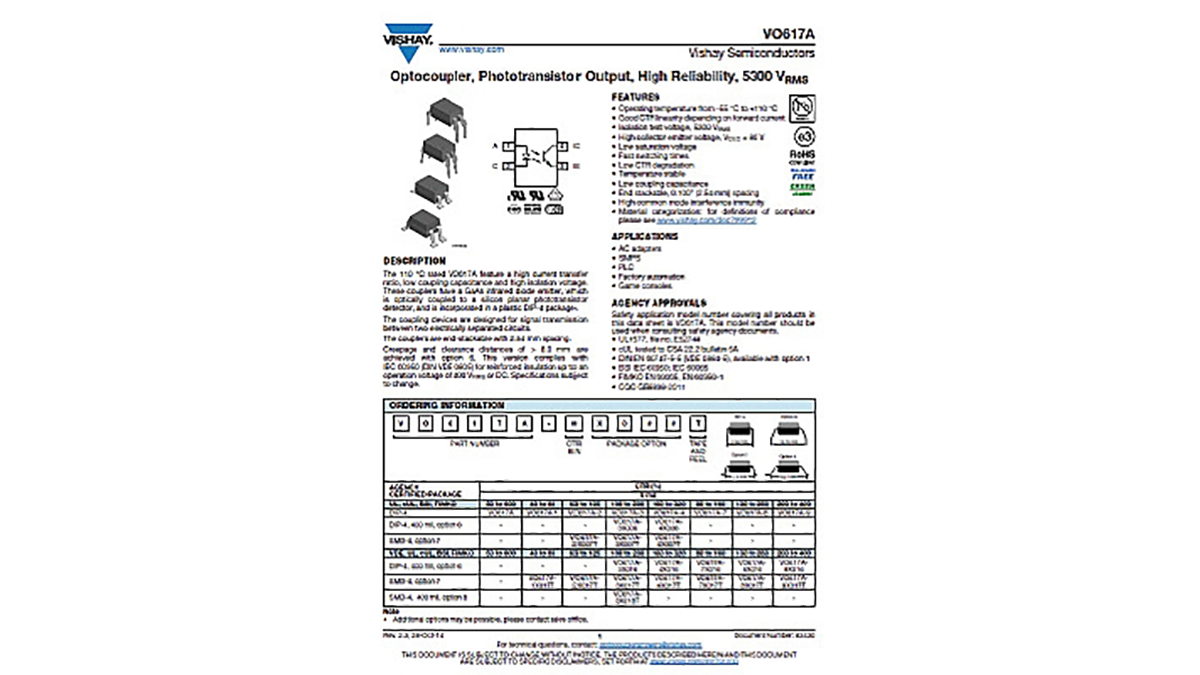
Datasheets generally begin with a header stating the product’s name, which is followed by a graphic representation of the package and symbol. Key features follow, with a list of the most popular applications and available safety agency approvals. An example has been given in Figure 1, which shows the introduction page for the VO617A. In general, all datasheets contain the following information:
- Description
- Features
- Applications
- Agency approvals
- Ordering information
- Absolute maximum ratings
- Electrical characteristics
- Current transfer ratio (CTR)
- Switching characteristics
- Safety and insulation ratings
- Typical static graphs
- Typical dynamic graphs
- Packaging dimensions, markings, and packaging
The description will introduce the product, the main product category, the technology used, and its features. Special specifications such as high operating temperature, high current transfer ratio, and low coupling capacitance are identified to give an overview. The application section introduces the most common applications using the component. The agency approvals section provides an overview of the product’s approvals to different standards and agencies. Above the description, a symbol and selection of package types are shown.
For more Details: Guidelines for reading an optocoupler datasheet
- How do optocouplers transfer electrical signals?
They transfer signals between two isolated circuits by using infrared light. - What is the main purpose of an optocoupler?
To prevent high voltages from affecting the side of the circuit receiving the signal. - What components form the main structure of an optocoupler?
An infrared light-emitting diode and a light-sensitive product such as a phototransistor. - What information does the first page of a datasheet provide?
It provides the main product description, features, suggested areas of applications, ordering information, and agency approvals. - Which specific optocoupler model is used as an example in the article?
The VO617A optocoupler with phototransistor output. - What are some key technical specifications found on following pages?
Operating conditions and graphs showing the behavior of the product. - Does the article mention current transfer ratio as a datasheet section?
Yes, Current transfer ratio (CTR) is listed as a required information section. - What safety-related information is included in a standard datasheet?
Agency approvals and safety and insulation ratings are provided.
