
Summary of The Batteryless UPS for the Raspberry Pi
The Juice4Halt module is a supercapacitor-based energy storage solution featuring two independent DC/DC converters. It interfaces between a stable 5V rail and a supercapacitor to provide backup power for devices like the Raspberry Pi during brownouts or short-term failures. The system charges the supercapacitor when external power is available and switches to step-up mode to supply the load if power fails, ensuring reliable operation without shutdowns.
Parts used in the Juice4Halt Module:
- Supercapacitor
- Bidirectional step-up/step-down DC/DC converter
- Front-end step-down DC/DC converter
- Stable 5V supply rail
- Raspberry Pi or Single Board Computer (SBC)
The Juice4Halt module is a supercapacitor based energy storage. It contains two independent DC/DC converters. The first one is a bidirectional step-up/step-down converter working as the interface between the stable 5V supply rail and the supercapacitor. During charging the converter works in step-down mode and transports energy from the external power supply to the supercapacitor. In case of a power failure the load device (Raspberry Pi or another SBC) is supplied from the supercapacitor via DC/DC converter working in step-up mode.
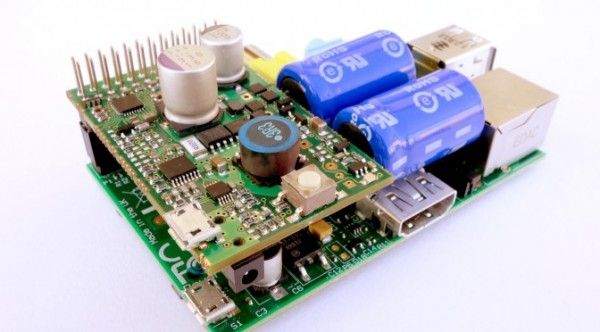
The second DC/DC converter is a Front-end step-down converter. The only function is converting a high input voltage down to 5.1V for the 5V rail. It is necessary to use the Front-end converter in case of an external power supply.
Modes of operation
Charge mode
- charging the supercapacitor using the step-down DC/DC converter when external power supply voltage is available at the input
- the load device at the output (Raspberry Pi or another SBC) stays disconnected from 5V power rail until supercapacitor charging is completed
Normal operation
- the Raspberry Pi (or another SBC) is powered from the external power supply
- the supercapacitor is directly connected to the 5V output to ensure reliable operation without short-term power failures or brown-outs
Brownout (or short-term power failure)
- starts when voltage falls below 4.9V
- external power supply will be disconnected
- Raspberry Pi or another SBC is powered from supercapacitor
- ends when voltage falls below 4.75V, at this point the external power supply voltage is being checked:
- when external power supply voltage is present reconnect to power supply and charge the supercapacitor back otherwise enter the Shutdown mode
For more detail: The Batteryless UPS for the Raspberry Pi
- How does the first DC/DC converter function during charging?
It works in step-down mode to transport energy from the external power supply to the supercapacitor. - What happens when voltage falls below 4.9V?
The external power supply disconnects and the device is powered by the supercapacitor via the step-up converter. - When does the Brownout mode end?
It ends when voltage falls below 4.75V and the external power supply voltage is checked. - Can the system power a Raspberry Pi during a failure?
Yes, the load device is supplied from the supercapacitor via the DC/DC converter working in step-up mode. - What is the purpose of the second DC/DC converter?
It converts high input voltage down to 5.1V for the 5V rail when an external power supply is used. - Does the load stay connected while the supercapacitor is charging?
No, the load device stays disconnected from the 5V power rail until supercapacitor charging is completed. - What occurs if external power is not present after voltage drops below 4.75V?
The system enters Shutdown mode instead of reconnecting to the power supply. - How does the system ensure reliable operation without brown-outs?
The supercapacitor is directly connected to the 5V output during normal operation to handle short-term power failures.
