
Summary of ChipStomp – A Digital effects pedal built with a ChipKit DP32
This article details the creation of a digital guitar effects processor named ChipStomp, inspired by experimental music sessions. The project utilizes a PIC32MX microprocessor to handle audio processing, leveraging its high speed and built-in peripherals. To manage the complex analog signal conditioning required for guitars, the builder integrated an open music labs Stomp Shield, which handles input gain, filtering, and PWM-based DAC output. The system features a custom UI with a rotary encoder and an OLED display, all powered by a Chipkit DP32 prototyping board.
Parts used in the ChipStomp:
- PIC32MX microprocessor
- Stomp Shield from open music labs
- Chipkit DP32
- Microchip PIC32MX250F128B chip
- 128x64px OLED display
- Three-pole anti-aliasing filters
- Twiddly potentiometers
- General purpose rotary encoder
Here’s something I’ve been working on for a while. It’s a digital guitar effects processor based on a PIC32MX.
It started with a conversation with my brother John. We were playing with my mini drum-machine, using the tune mode to mash the hell out of the samples whilst running it though his bass guitar amp with some heavy feedback. It sounded pretty cool, very NIN and got us onto the idea of making a digital effects pedal using the same microprocessor. The PIC32MX is a pretty capable device running at up to 50Mhz with loads of built-in peripherals including a 10bit ADC. Definitely possible I thought.
The tricky part was going to be handling the analogue input. That needed some research, as I had no idea what sort of voltage range to expect from a Guitar. Wikipedia indicates that the range could be from 100mV to 1V rms with peaks of +/-10V if you’re really going for it! That’s not something I’ve dealt with before, so a bit more Google-ing lead me to the Stomp Shield from open music labs. This is an Arduino shield aimed precisely at what I wanted. It provides the analogue front-end to condition the incoming audio signal for the ADC and uses an interesting arrangement of two PWM DACs to get a high-resolution audio output. It also provides low-pass filters on the input and output stages (“3-pole anti-aliasing filters for the inputs and outputs (10kHz cutoff)” from the wiki), twiddly potentiometers to control the input gain, the wet/dry mix, analogue feedback and the final output volume. Plus a general purpose rotary encoder for the UI. Nice!
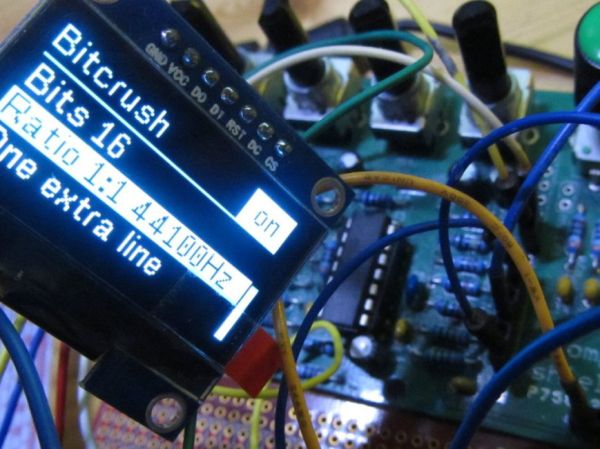
Preferring to stick with the PIC32 I came up with this combo of the Stomp Shield, a Chipkit DP32 plus a 128x64px OLED bought from Aliexpress for the UI display.
The shield layout is intended for a “real” Arduino so It’s a bit of a mess in this state but it works pretty well.
The DP32 is a simple prototyping platform for the Microchip PIC32MX250F128B which is the USB capable twin of the chip I’ve been using in the drum-machine. Same 32Kb RAM and 128Kb flash but with hardware USB built-in.
For more detail: ChipStomp – A Digital effects pedal built with a ChipKit DP32
- What inspired the creation of this digital effects pedal?
A conversation with the author's brother while using a mini drum-machine and bass guitar amp created heavy feedback sounds that led to the idea. - How does the project handle the analogue input voltage range?
The Stomp Shield conditions the incoming audio signal, as guitar voltages can range from 100mV to 1V rms with peaks up to +/-10V. - What specific filters are included in the design?
The design uses three-pole anti-aliasing filters on both the input and output stages with a 10kHz cutoff frequency. - How is the high-resolution audio output achieved?
The system uses an arrangement of two PWM DACs provided by the Stomp Shield to generate the audio output. - Which microcontroller serves as the core processing unit?
The project is based on the PIC32MX running at up to 50Mhz with built-in peripherals including a 10bit ADC. - What components control the user interface parameters?
Twiddly potentiometers control input gain, wet/dry mix, analogue feedback, and output volume, alongside a general purpose rotary encoder. - Why was the Chipkit DP32 selected for this build?
The DP32 is a simple prototyping platform for the Microchip PIC32MX250F128B which includes hardware USB capabilities.
